The Off-Hand Pause: A Week of Starting Dinner With Your Other Hand
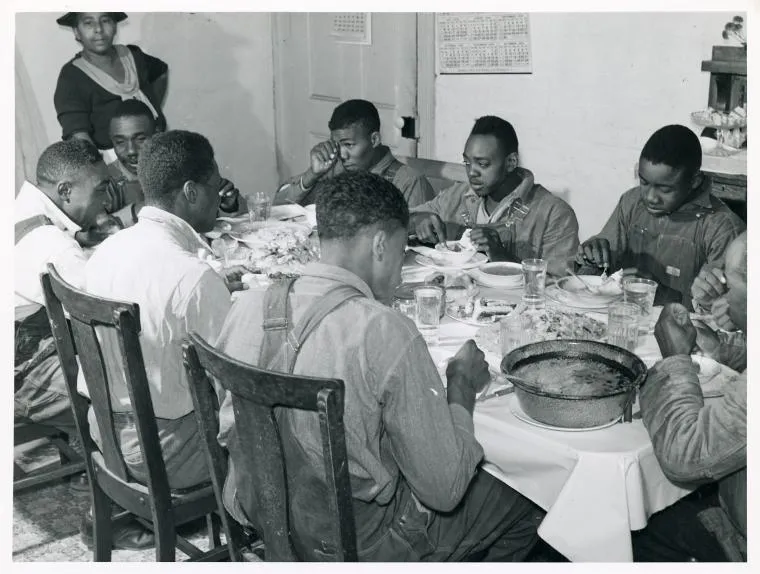
Photo: Marion Post Wolcott, Public domain, via Wikimedia Commons
Winter dinners have a way of speeding up even when the days slow down. You come in from the cold, plate something warm and filling, and suddenly the fork is scraping the bottom before you’ve really registered what you ate. That’s not a character flaw; it’s efficiency. But efficiency isn’t always helpful when the goal is to eat at a pace that lets you notice fullness, flavor, and the fact that you’re actually sitting at a table.
The trick here is almost embarrassingly small: use your non-dominant hand for the first three bites of a meal. That’s it. Not the whole dinner. Not every snack. Just the opening moves, when autopilot tends to be strongest.
Why the first few bites are worth a second look
Most eating habits are built on repetition. You sit down, pick up the fork with the same hand, and start moving at the same pace you always do. The first three bites are often the least conscious part of the meal—you’re still settling in, maybe talking, maybe scrolling, maybe just hungry.
Slowing those opening bites doesn’t magically change your metabolism or turn a casserole into a health food. What it can do is interrupt the groove. Researchers who study eating behavior often point out that pace matters: faster eating tends to be associated with eating more before fullness signals catch up. But those findings are about patterns across groups, not a guarantee about any one person at any one dinner. The point isn’t to hack your hormones. It’s to create a tiny pause where awareness can sneak in.
The actual habit, minus the gymnastics
Pick one meal to start with—probably dinner, since winter meals tend to be the heaviest and the most automatic. Hold your fork, spoon, or sandwich in your non-dominant hand for the first three bites. Then switch back to your usual hand and carry on like a normal person.
A few practical notes:
- Keep the meal the same. This isn’t about changing what’s on your plate, counting calories, or swapping in a salad. It’s about the first 30 to 60 seconds of eating.
- Don’t fight the mechanics. If you’re having soup, hold the spoon in your other hand. If it’s a sandwich, pick it up with the other hand. If it’s a fork-and-knife situation, keep the knife where it is and just let the fork hand switch. Awkward is fine; complicated is not.
- Count loosely. Three bites is a rough marker, not a rule. If you lose track, you’ve probably already gotten the benefit of the pause.
- Skip it when it would be weird. A work dinner, a first date, a holiday table with your partner’s grandmother—none of these are the moment to stage a handedness experiment. Use it at your own kitchen table first.
What it may help with—and what it won’t
The realistic upside is pretty modest, which is exactly why it’s worth trying. Using your other hand makes the first few bites slightly more deliberate. That extra second or two can be enough to notice that the food is hotter than you thought, that you’re hungrier than you realized, or that you’re eating because it’s 6:30 and not because you’re actually starving.
Some people find that this small pause carries forward. They eat the rest of the meal a little more slowly, put the fork down between bites, or stop before the plate is clean. Others notice nothing beyond a mildly clumsy start. Both outcomes are normal.
What it won’t do is override hunger, make portion control automatic, or replace the more substantial habits that shape intake—things like what you keep in the kitchen, how often you eat out, and whether you’re getting enough sleep. It’s also not a weight-loss strategy. Think of it as a rehearsal for noticing, not a fix.
A one-week trial that doesn’t take over your life
Here’s a low-stakes way to test it:
Days 1–2: Dinner only. Use your non-dominant hand for the first three bites. Then switch back. No tracking, no judging.
Days 3–4: Add lunch if it’s easy. If lunch is a desk sandwich, fine. If it’s a messy bowl of chili in a shared office kitchen, maybe skip it.
Days 5–7: Pay attention to the aftertaste, not the scorecard. At the end of each dinner, ask yourself one question: Did I notice anything different about how fast I ate or how full I felt? A simple 1-to-5 note on your phone is plenty.
At the end of the week, you’ll know whether this is a keeper or a party trick. If it made dinner feel like a chore, drop it. If it gave you a useful half-second of awareness, keep it for heavier meals—the stews, the pot pies, the holiday spreads that tend to disappear before you’ve tasted them.
The winter-meal version
The habit fits especially well this time of year because winter meals are often soft, warm, and easy to eat fast. A bowl of chili, a plate of lasagna, a leftover casserole—none of these demand much chewing, which makes them easy to inhale. The first three bites are a chance to check the temperature, taste what you’re eating, and confirm that you’re actually hungry and not just cold.
You can pair it with one other small move: put your utensil down between the first few bites. Not for the whole meal, just long enough to let the pause land. If you’re at a holiday table, you can do the same thing by taking a sip of water after the first bite. Nobody will notice, and you’ll still be part of the conversation.
Bottom line
Swapping hands for the first three bites is not a magic trick. It’s a tiny interruption to a very old habit, and tiny interruptions are sometimes all it takes to eat with a little more attention. Try it for a week at your own table. If it helps you slow down during heavy winter meals, great. If it doesn’t, you’ve lost nothing but a few clumsy forkfuls.