Barefoot by the Bathroom Counter: The Ten-Second Balance Habit Worth Keeping
Most of us don’t think about balance until something goes wrong—a stumble on a curb, a near-miss in the shower, a yoga class that suddenly feels harder than it used to. But balance is one of those quiet skills that responds well to small, regular doses of practice. And one of the easiest places to notice it is right next to the sink.
This isn’t about turning your morning routine into a fitness test. It’s about a ten-second check you can repeat often enough to spot trends, plus a few simple ways to make standing on one foot a little more interesting. Think of it as a low-key habit, not a pass/fail exam.
Why the bathroom counter is a surprisingly good testing spot
The bathroom has three things going for it: a sturdy counter within arm’s reach, a flat floor, and a routine you already do twice a day. That makes it a practical place to sneak in a balance check without adding a new appointment to your calendar.
You’re also usually barefoot or in socks, which gives your feet more information than thick-soled shoes do. And because you’re already standing still while brushing, you’re not really adding time—just redirecting a few seconds of attention.
The goal is not to balance like a flamingo. It’s to get a rough sense of how steady you are on each side, and whether that changes over weeks or months.
How to run the ten-second check safely
Keep it simple and keep it safe. You are not trying to impress anyone, and there is no prize for wobbling dramatically.
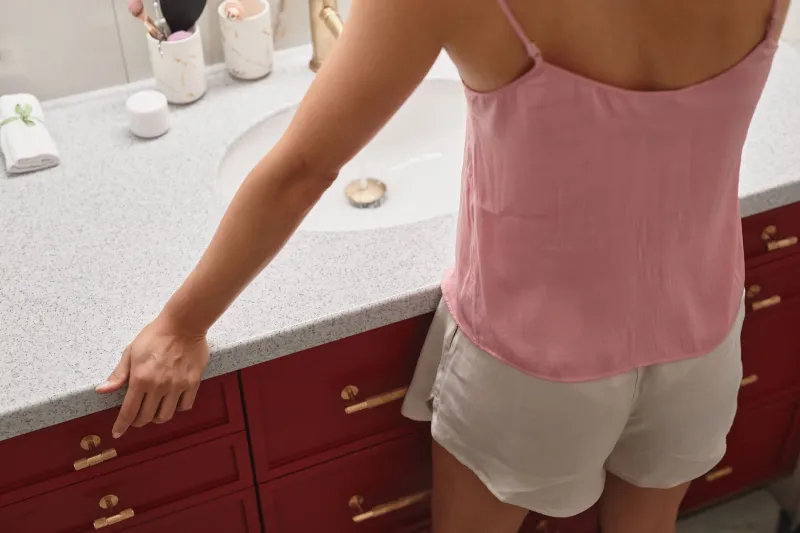
- Stand near the bathroom counter with one hand hovering a few inches above it. You don’t need to grip it, but it should be there if you need it.
- Shift your weight onto one foot and lift the other foot slightly off the floor—just an inch or two is fine. You don’t need to pull your knee up high.
- Start a timer for ten seconds, or count slowly in your head. Keep your gaze on a fixed point in front of you.
- Notice what happens: Do you stay fairly still? Does your ankle make small corrections? Do you need to touch the counter? Repeat on the other side.
A few ground rules: do this barefoot or in socks on a dry floor, not on a bath mat that can slide. Skip it if you’re dizzy, recovering from an injury, or feeling unwell. And if you live with a condition that affects your balance or sensation, talk with a clinician before making it a regular practice.
What ten seconds can tell you
Single-leg stance time is a blunt tool, not a diagnosis. But it’s still useful. In general, many healthy adults can hold a single-leg stance for at least ten seconds, though norms vary by age and testing conditions. The more informative part is often the comparison: Is one side noticeably steadier than the other? Has your ten seconds become a shaky five? Do you need the counter more than you used to?
Research on balance and aging has repeatedly linked poorer balance with higher fall risk, and falls are a major reason older adults lose independence. That sounds heavy, but the practical takeaway is lighter: balance is trainable, and small improvements can matter. A ten-second check is simply a way to keep an eye on it without turning it into a source of anxiety.
It’s also worth remembering that balance isn’t one single skill. It draws on vision, inner-ear function, proprioception (your body’s sense of where it is in space), and strength. A rough day on one foot doesn’t mean something is wrong. A pattern over time is more interesting than a single reading.
Three progressions that take a minute or less
Once the basic check feels easy, you can make it slightly more challenging. Keep the counter nearby for all of these, and stop if anything feels unsafe.
1. Add a slow head turn
Stand on one foot as before, but slowly turn your head to the left and then to the right while you hold for ten seconds. This asks a little more of your balance system without adding equipment. Keep the movements small and controlled.
2. Try a tandem stance
Instead of lifting one foot, place one foot directly in front of the other, heel to toe, like you’re standing on a tightrope. Hold for ten seconds, then switch which foot is in front. This narrows your base of support and gives your ankles and hips a different challenge.
3. Practice a slow march
Stand tall near the counter and lift one knee slowly, then set the foot down. Alternate sides for thirty seconds. The point is control, not speed. If you feel wobbly, reduce the height of the knee lift.
You can rotate these through the week, or just pick one and stick with it for a month. The habit matters more than the variety.
When to mention it to a clinician
A ten-second balance check is not a screening test, and it shouldn’t be used to self-diagnose. But it can be a useful conversation starter. Bring it up if you notice a sudden change in steadiness, if you’ve had a fall or near-fall, if one side feels consistently much weaker, or if balance problems are interfering with daily life.
In the US, that conversation can happen at an annual physical or a routine visit. You don’t need a dramatic story. “I’ve noticed I’m wobblier on one foot than I used to be” is enough. A clinician can help sort out whether it’s something simple—like footwear, vision, or a minor injury—or something that deserves a closer look.
The bigger point: small reps, real returns
Balance practice doesn’t need a balance board, a gym membership, or a thirty-minute block. It needs repetition, a safe setup, and a little patience. Brushing your teeth is already a twice-daily anchor. Adding ten seconds of single-leg standing—or one of the progressions—turns that anchor into a tiny training session.
You might not notice dramatic changes week to week. That’s normal. The win is consistency: a small habit that keeps you connected to how your body is moving, and gives you an early heads-up if something shifts. One foot, ten seconds, most mornings. That’s a pretty reasonable return on investment.